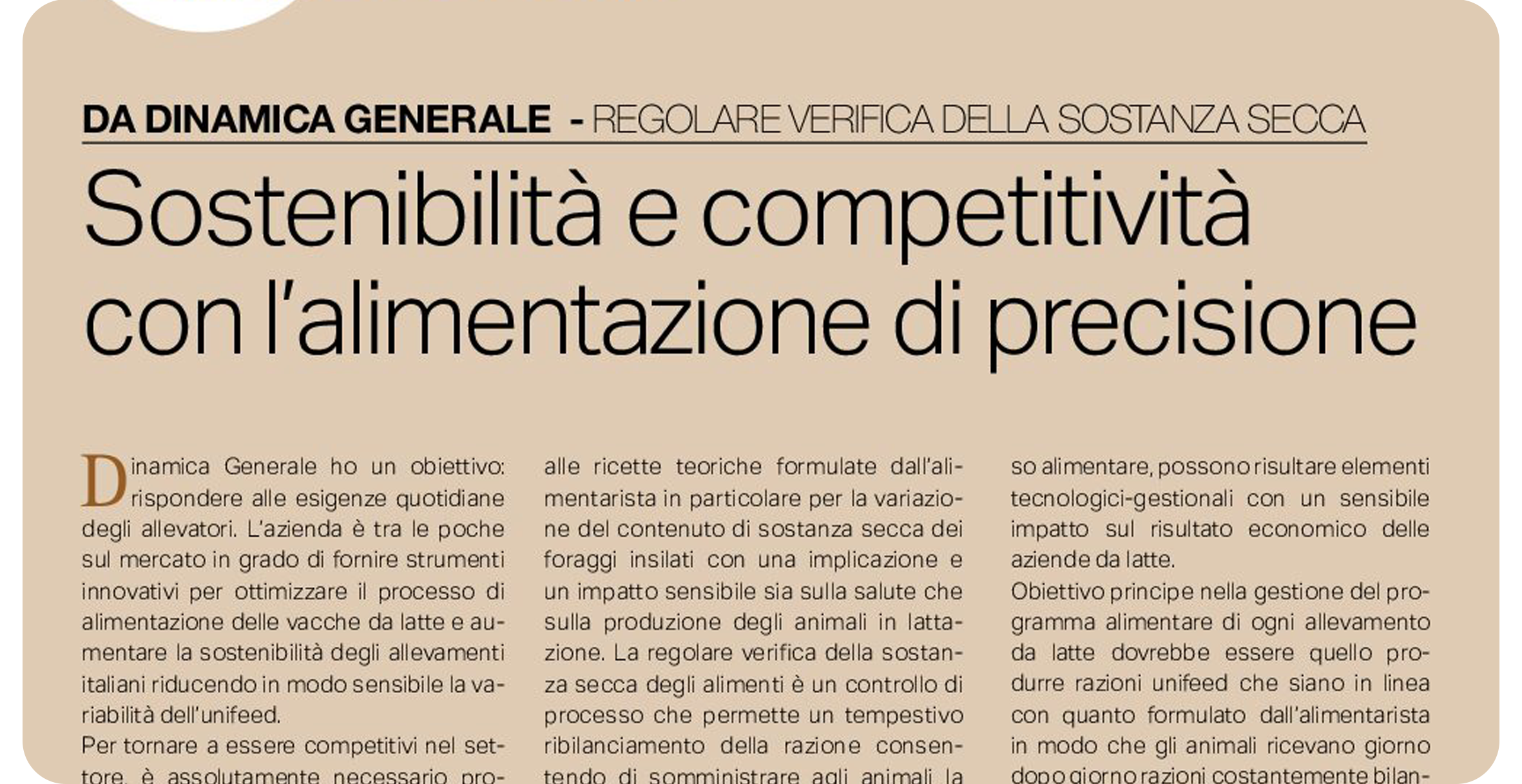
Dinamica Generale I have a goal: to respond to the daily needs of dairy farmers. The company is among the few on the market that can provide innovative tools to optimize the dairy cow feeding process and increase the sustainability of Italian dairy farms by significantly reducing unifeed variability.
To become competitive again in the industry, it is absolutely necessary to try new ways. Livestock feeding costs account for about 60 percent of total production costs, which is why managing variability in animal feed can have a direct impact on the macro cost of feeding and the associated economic return.
The unifeed ration is characterized by a high risk of deviation from the theoretical recipes formulated by the nutritionist in particular due to variation in the dry matter content of silage fodder with an implication and appreciable impact on both the health and production of lactating animals. Regular verification of the dry matter of the feeds is a process control that allows timely rebalancing of the ration allowing the animals to be fed the ration actually formulated by the nutritionist.
The result is therefore a potentially considerable economic benefit to livestock farming both in terms of improved production performance and reduced waste of expensive feed.
On-farm implementation of precision feeding systems, as a result of reducing variability in the management of the feeding process, may prove to be technological-managerial elements with a significant
impact on the economic performance of dairy farms.
The main objective in managing the feeding program of any dairy farm should be to produce unifeed rations that are in line with what the nutritionist formulates so that the animals receive consistently balanced rations day after day.
However, in reality, there are many variables that result in appreciable deviations in the actual composition of a ration fed at the feeder.
Reducing this variability is a very important goal for herd health and productivity, but more importantly for the herd’s income statement.
Dinamica Generale and Granda Team are working in partnership on the Italian market to offer a differentiating alternative for breeders who choose to invest in technology in order to obtain a concrete economic return and reduce costs.
The union of complementary specialized skills such as those of Granda Team and Dinamica Generale has resulted in a team of professionals qualified to govern the best technology on the market today. The integrated method of livestock management applied by Granda Team and Dinamica Generale is aimed at increasing farmers’ sensitivity to the control of feed variability and continuous monitoring of barn performance to improve the sustainability
of livestock farming day by day.
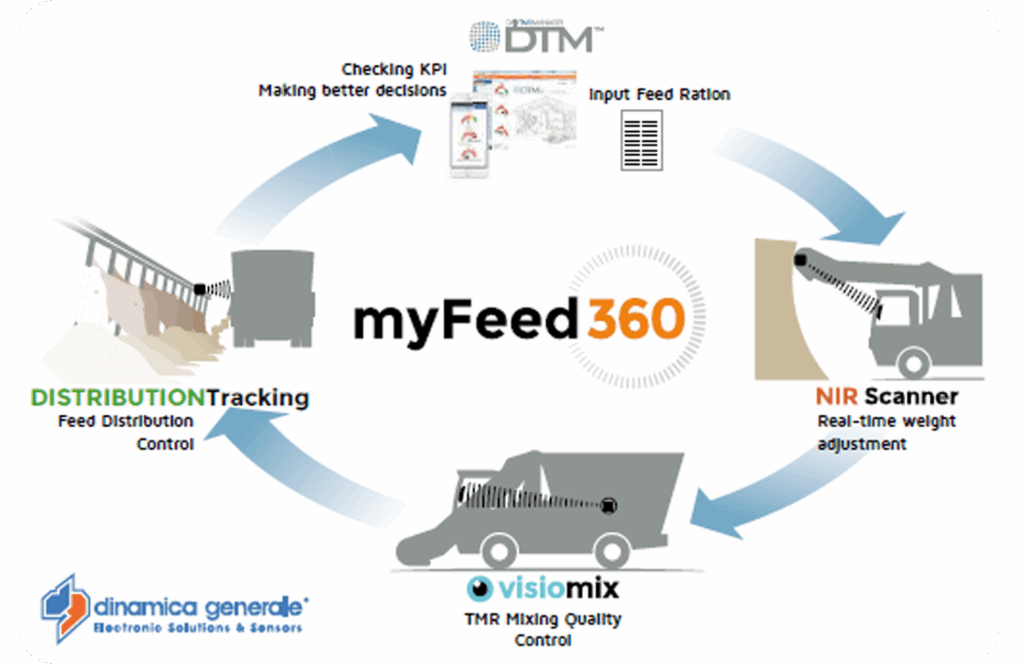
With scalable weighing systems optimized to be integrated with advanced precision feeding systems, Dinamica Generale offers a program called MyFeed 360. The great competitive advantage offered by Dinamica Generale is that it allows any livestock farmer at
to introduce a basic precision feeding system consisting of weighing system and feeding management software on the farm with minimal investment.
Subsequently, the farmer can decide to add new technologies such as NIR analysis on the mixer wagon to improve control of the ration preparation process and measure feed dry matter in real time recalibrating ration preparation for animals.
Or, integrate Visiomix to the mixer wagon to control mixing quality in terms of fiber length and homogeneity. Or choose to control the distribution stage to know how much unifeed has been discharged for each group of animals. All governed by DTM feed management software that allows milk production data to be imported from the most popular software in milking parlors around the world and quickly provide the farmer with IOFC index-the parameter that indicates the revenue from milk sales net of feed costs-error indices at both feed loading and ration distribution stages, to name just a few.
My Feed 360 offers a unique competitive advantage available to farms looking toward a more sustainable near future.
by Matteo Reggiani
Click here to view the article from “Informatore Zootecnico”


 NIR & Imaging
 Data Management
 Mobile Apps
 Load Cells
 Indicators and ECU
 Accessories
 English
 Italian
 Spanish
 French
 German
 Portuguese (Brazil)
 Dutch
Dutch Polish
 Chinese (Simplified)
 Turkish