by STEFANO BERNI DIRECTOR GENERAL OF THE GRANA PADANO TUTELA CONSORTIUM
We have been predicting, saying and writing this for many months now, even when the price of spot milk was very high a year ago and might have mistakenly portended rosy and lasting times.
And that is, we had long argued that two factors would intervene to change that very favorable situation:
It should be noted, however, that this will be a reduction and not a zeroing of the historic differential in favor of the Italian stables. This is fundamentally because of the cost of transporting milk from Northern Europe to Italy and, above all, because of the presence of PDOs and, consequently, milk that, by law, must be Italian.
These two aspects will ensure that Italian milk will be more profitable than milk from beyond the Alps, but the average differential of 25-30% will be around 15%. Thus, it will be German and French milk, paid at the farmgate, that will determine the price of milk at Italian dairies in the medium term.
And since post-milk quota production increases do not portend rising values and prices, it is advisable to prepare for maximum optimization of production costs.
So Italian producers will never be asked to produce at German or French costs (mission impossible), but to look with increasing attention to the performance improvement needs of their barns. Accustomed as we have always been to evaluating them primarily in terms of quantitative productivity, we will have to move toward looking more pointedly at the cost of producing a liter of milk.
In fact, pushed yield does not always coincide with the best economic result, because it will be necessary for the livestock entrepreneur to monitor and analyze, one by one, all the items that contribute to building the cost of milk production. Great curiosity and willingness to compare among entrepreneurs are needed so that we can all get as close as possible to the best condition in being.
This confrontation will have to take place directly between breeders and online, using information tools that in part already exist and in part will need to be implemented.
The same principle and the same need obviously apply to processors, who must make quality excellence the distinguishing feature from generic products from beyond the Alps and the need for increasing strategic synergies among dairy company managers as a fundamental and inevitable tool for staying in an increasingly competitive market.
It must be said that much has been done in this regard, but the room for improvement and optimization is still significant and therefore encouraging.
In this regard, the Consortium is finishing an important scientific work called “FILIGRANA,” which concerns monitoring aimed at quality improvement on the entire Grana Padano supply chain and also highlights significant areas of both operational and quality improvement in the dairy.
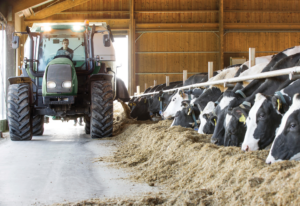
Within that research project, for example, there is a chapter devoted to improving food ration management.
From this part of the research, through a system called “precision feeding,” it was found that more careful management of the daily feed ration produces lower costs, better animal health and thus better economic results, which the Scientific Commission officially estimated to range from a minimum of 1.8 cents to a maximum of 6 cents per liter of milk.
It is evident how useful, in the new phase of the post-milk-quota system, this or similar tools and initiatives aimed at improving in a global and not just unilateral (I produce more) sense the performance of stables and dairies, in order to make them more competitive and more adherent to the new demands that have already appeared.
Needs that, if not addressed with adequate determination and attention, could generate great difficulties for dairy farming and, consequently, for the entire Italian dairy sector, especially those that use or have decided to use only or predominantly Italian milk.
Curiosity, knowledge and comparison are the most valuable tools that will enable us to improve in order to face the free market with greater serenity and conviction of the outcome, strong in our advantages but aware of our weaknesses.
Only in this way will improvement be secure and guarantee the future of Italian dairy farming and dairy companies devoted to the use of Italian milk.
View here the article


 NIR & Imaging
 Data Management
 Mobile Apps
 Load Cells
 Indicators and ECU
 Accessories
 English
 Italian
 Spanish
 French
 German
 Portuguese (Brazil)
 Dutch
Dutch Polish
 Chinese (Simplified)
 Turkish