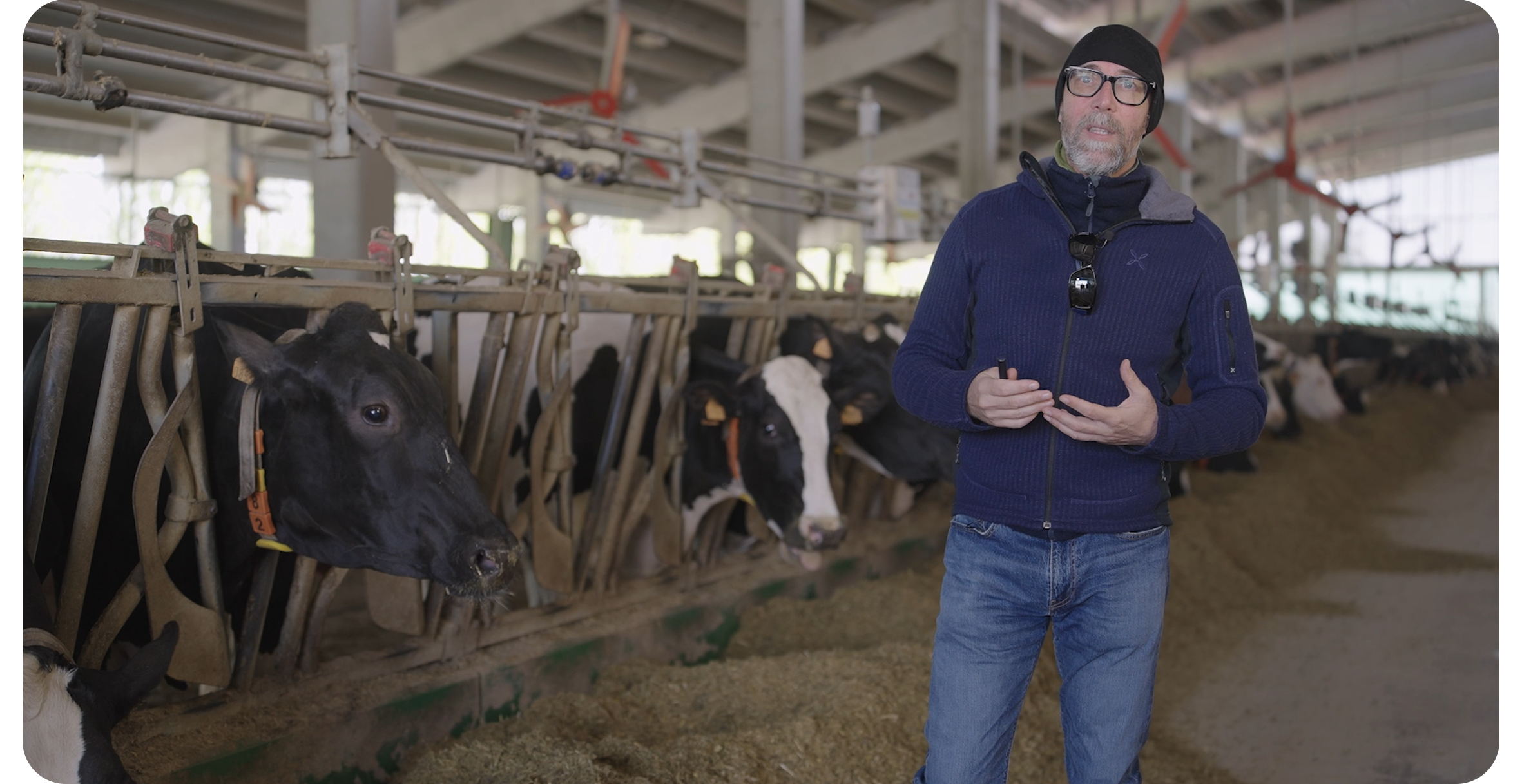
In dairy farming, one of the most important – and often underestimated – parameters is dry matter intake.
From this, everything starts: milk production, herd health, and the economic efficiency of the farm. Monitoring feed intake does not simply mean “looking at the feed bunk”, but measuring every day what cows actually eat, group by group, and acting accordingly.
Cristian Rota, PhD in Agricultural Management, addresses this topic in a video from which this article is derived, sharing a practical approach to daily feed bunk management.
Dry matter intake (DMI) is the real driver of milk production. If we don’t know it, we cannot truly understand whether the ration is working.
Monitoring DMI on a daily basis allows farmers to:
The key is to adopt a daily, consistent protocol that makes it possible to compare data day after day and make informed decisions.
To accurately estimate intake, it is essential to monitor feed refusals.
Refusals:
If the level of refusals does not match expectations, it is a clear signal that something needs to be corrected the following day. The real value of daily monitoring lies precisely here: turning data into concrete actions.
One of the most serious problems, both for cow health and farm profitability, is finding the feed bunk empty or only partially filled during the day.
An empty feed bunk means:
As Cristian Rota often states in the video: “The last bite before midnight is the one that makes me the most money.”
Having feed available 24 hours a day is a fundamental condition for a productive and efficient herd.
Feed refusals must be managed and measured, not ignored. If refusals are not monitored:
When refusals are significantly different from the original mixed ration, it means cows are sorting the feed. This is detrimental to rumen health, intake uniformity and overall herd productivity
The goal is to place the animal every day in the optimal condition in terms of feed availability and space.
The concept of feed efficiency can have two different interpretations.
1 – Efficiency as milk produced per unit of dry matter intake
In this case, it depends on:
2 – Efficiency as reduction of feed waste
Here, the focus changes completely. It goes beyond ration formulation and physiology, and centers on daily intake control.
It means:
A ration managed properly every day improves both process efficiency and animal productivity.
The feed bunk is where the highest production cost on the farm is concentrated. Today, feeding costs can reach approximately €30 per 100 kg of milk produced. In a herd of 600 cows, the economic value flowing through the feed bunk – including waste – can approach €2 million per year.
That is why:
Properly managing intake, refusals, and feed waste is not just a good practice, but a concrete driver of profitability. The difference between an efficient farm and one that loses margins every day often starts right there: at the feed bunk, measured and managed with method, every single day.
Watch the full video, click here!


 NIR & Imaging
 Data Management
 Mobile Apps
 Load Cells
 Indicators and ECU
 Accessories
 English
 Italian
 Spanish
 French
 German
 Portuguese (Brazil)
 Dutch
Dutch Polish
 Chinese (Simplified)
 Turkish
