Introduction
In modern livestock farming, precision feeding has become essential to ensure animal welfare, economic efficiency, and environmental sustainability. However, one often-overlooked factor can undermine even the most carefully formulated rations: TMR homogeneity.
Even if the ingredients are correct and quantities match the recipe, uneven mixing can negate all the effort invested in nutritional planning. In this article, we examine what homogeneity is, why it matters, and how it can now be monitored in real time thanks to NIR sensors and Dinamica Generale’s DTM software.
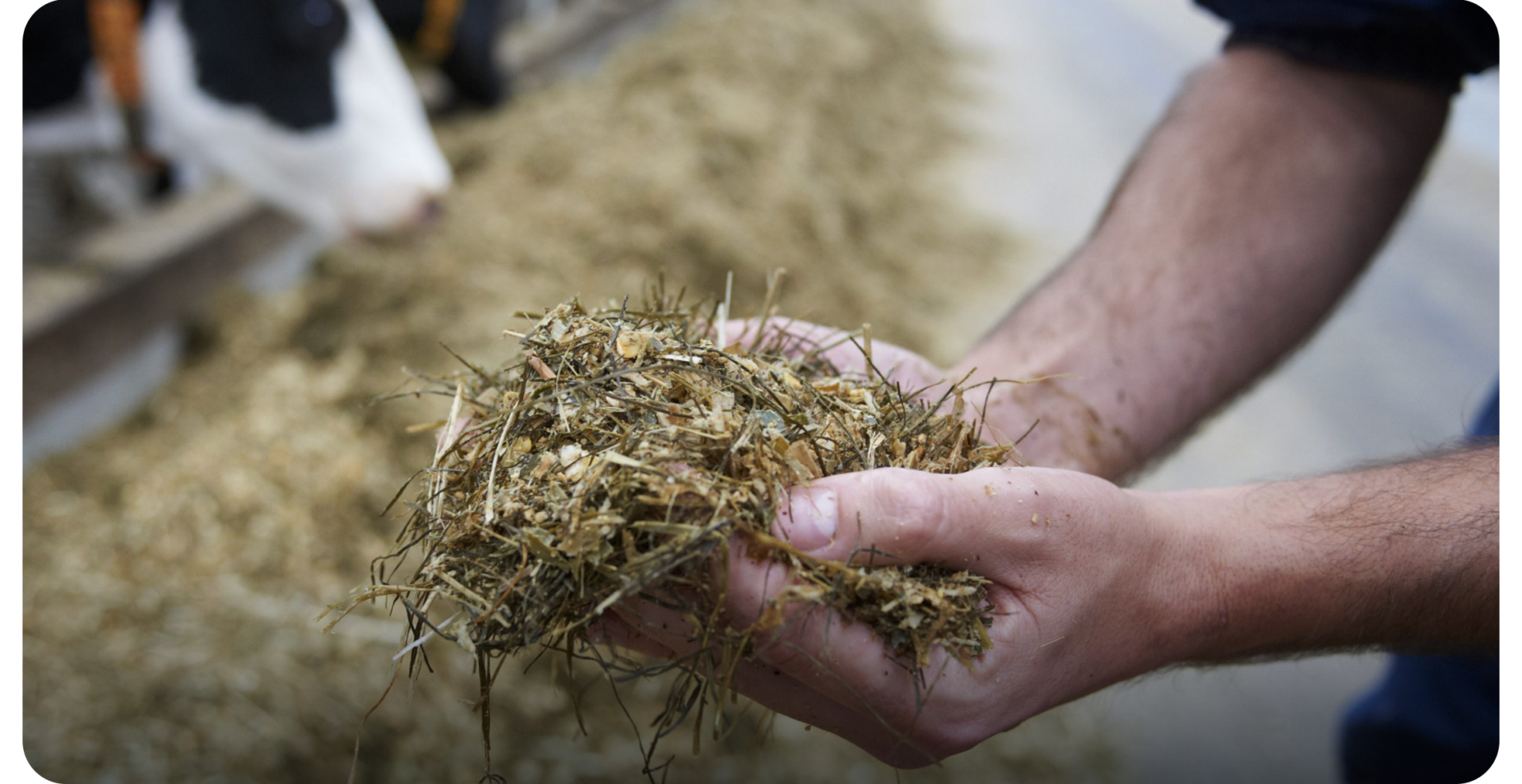
TMR homogeneity refers to how evenly the ingredients are distributed within the feed mixer.
A homogeneous TMR ensures that every bite consumed by the animals contains similar proportions of dry matter, protein, fiber, energy, and minerals.
When the mix is not homogeneous, animals may ingest different nutrient profiles, leading to metabolic imbalances, selective feeding, and production losses.
Selective feeding: animals choose only the most palatable parts, neglecting essential fiber and minerals.
Subacute ruminal acidosis (SARA): caused by rapid fluctuations in rumen pH due to high-starch rations.
Production losses: inconsistent intake and increased refusals reduce feed efficiency.
Variability among groups: dominant animals may access different rations compared to subordinate ones.
A study published in the Journal of Dairy Science (Zebeli et al., 2012) showed that ration uniformity is directly correlated with stable feeding behavior and rumen health in dairy cattle.
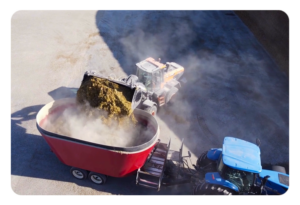
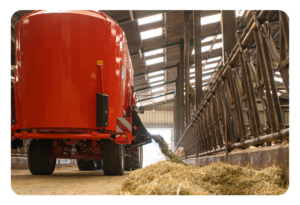
Near Infrared Reflectance (NIR) technology allows for real-time analysis of TMR nutritional parameters during loading and mixing.
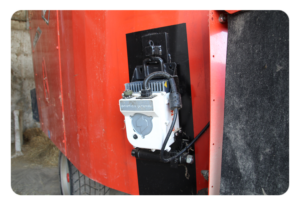
Dinamica Generale has developed an exclusive solution with the EVONIR sensor, which can be installed on the side of the mixer wagon, where it continuously reads values for:
These data allow tracking the evolution of the mix over time and observing whether nutritional variability decreases (homogeneous mix) or persists (non-homogeneous mix).
Traditionally, TMR homogeneity was assessed empirically by observing animal behavior or collecting manual samples for lab analysis.
Today, thanks to the EVONIR sensor installed directly on the side of the mixer wagon, it is now possible to measure mix uniformity in real time during the loading and mixing process.
The sensor continuously reads NIR parameters as the TMR passes in front of the measurement point, detecting:
This continuous analysis allows you to:
In other words: homogeneity is no longer a subjective visual assessment — it is now a measurable, actionable parameter directly on the machine.
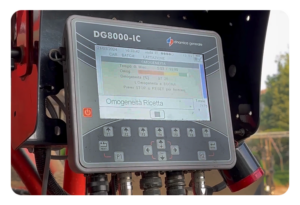
Although no international standard yet exists to quantify homogeneity with a single value, Dinamica Generale has integrated several tools into the DTM software to interpret and leverage this data in a practical way.
Available functions:
All of this is visible directly on a smartphone or tablet through the DTM App, available for Android and iOS.
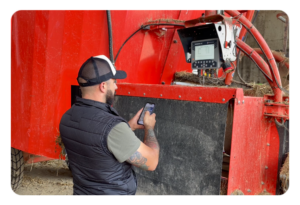
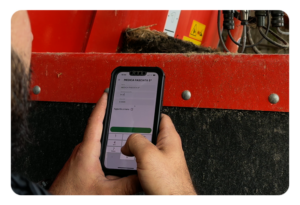
Although homogeneity is not yet a direct line item on farm financial statements, it strongly impacts key economic and production KPIs, such as:
According to a Cornell University study (Grant, 2010), an uneven mix can reduce milk production by up to 5% compared to a well-mixed ration, even with identical nutrient content.
In a precision feeding system, it is not enough to dose ingredients correctly — they must also be perfectly mixed.
Thanks to the integration of EVONIR and DTM, it is now possible to visualize, correct, and optimize every load in real time.
Homogeneity is no longer a visual guess — it is a measurable, actionable parameter.
Watch the video: click here!


 NIR & Imaging
 Data Management
 Mobile Apps
 Load Cells
 Indicators and ECU
 Accessories
 English
 Italian
 Spanish
 French
 German
 Portuguese (Brazil)
 Dutch
Dutch Polish
 Chinese (Simplified)
 Turkish
